


Your Website Has a New Visitor. And It Isn't Human.

Your website has a new visitor. And it isn't human.
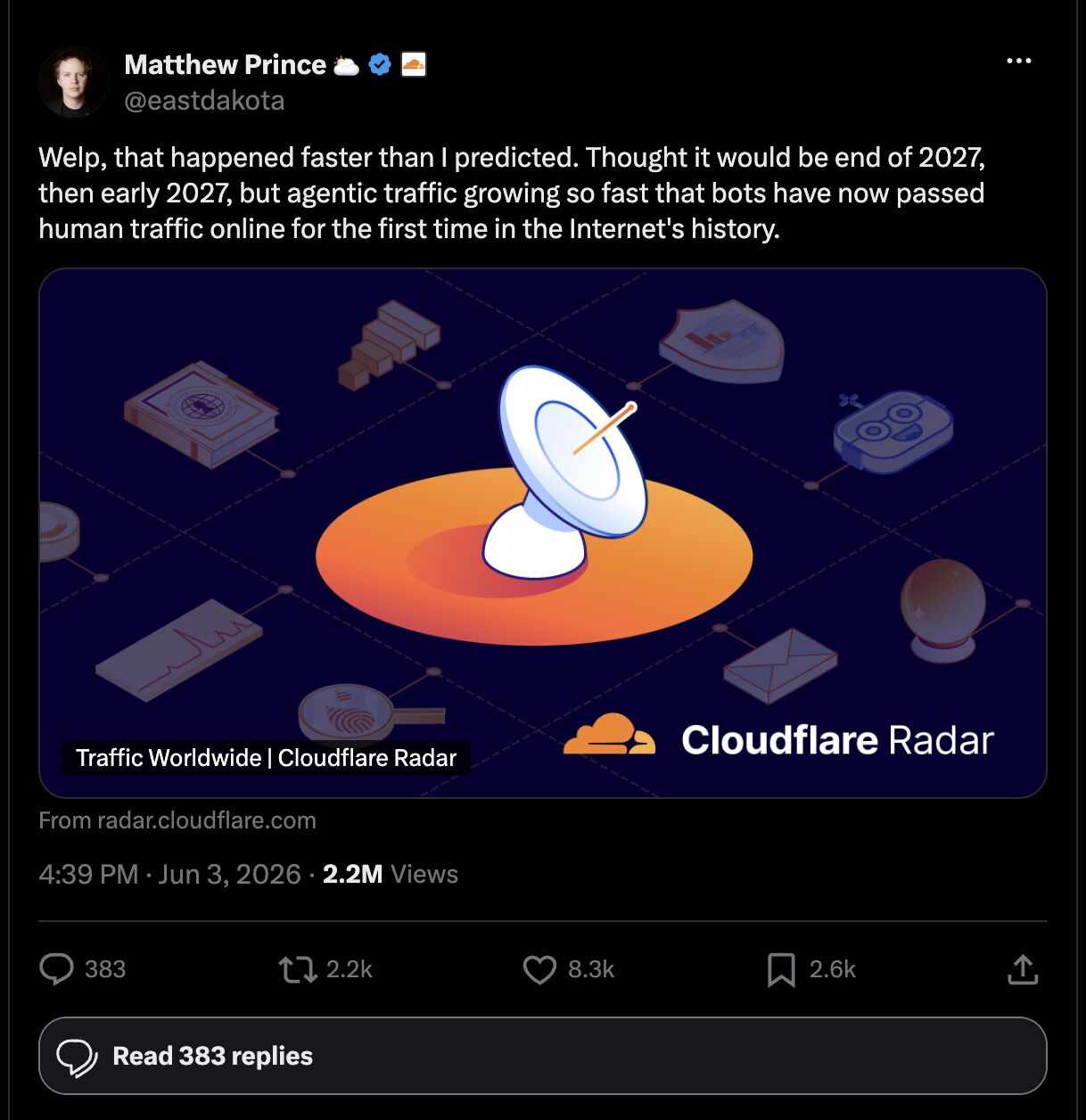
According to Cloudflare, bots now account for 57.5% of all HTTP requests to HTML pages globally. The 2025 Imperva Bad Bot Report confirmed it independently: automated traffic hit 51% of all web traffic in 2024, the first time in a decade that non-human traffic overtook human traffic on the internet.
And it is accelerating. AI-driven traffic grew 187% in 2025 — nearly eight times faster than human web activity.
Most websites were built for one type of visitor. They now need to work for two.
Two Separate Questions to Ask About Your Website
The conversation about AI traffic tends to get collapsed into one. It shouldn't. There are two distinct types of AI visitors, and they have different implications for how your site needs to work.
Question 1: Are You Being Recommended?
When someone asks Claude, ChatGPT, or Perplexity "what's the best tool for X," do you come up?
A growing portion of buyers skip the Google results page entirely. They ask an AI, get a shortlist, and then visit the sites on it. The research stage is invisible to you. No session in your analytics. No referral source. A human still lands on your page eventually — but only if you made the shortlist.
Getting on that shortlist is the new SEO. It is called AEO: Answer Engine Optimisation. The premise is simple. AI models surface content that directly answers questions with clarity and specificity. If your site is vague, jargon-heavy, or structured for humans to browse rather than machines to parse, it will not be recommended.
Clear, structured, authoritative content that answers the questions your buyers are asking. That is what gets cited.
Question 2: When an Agent Visits Your Site, What Can It Do?
This is different from the recommendation question, and it is the category growing fastest.
Agentic traffic — AI agents performing tasks autonomously on behalf of users — grew almost 8,000% in 2025. No human ever touches the page. The agent browses, compares, checks pricing, and reports back to the person who sent it.
The Cloudflare CEO put it clearly: a human shopping for something might visit five websites. An AI agent doing the same task might query 5,000.
Beautiful design, gradient heroes, and emotional copy do not register. What matters is whether the agent can extract clear information. What does this company do? Who is it for? What does it cost? What makes it different?
If those answers are buried in animations, locked in images, or written in vague marketing language, the agent moves on in milliseconds.
The Reader Mode Test
Here is a quick test you can run right now.
Open your website. Right-click and select Reader Mode.
That is roughly what an AI sees. Design stripped away. Just text, structure, and hierarchy.
With all of that removed, can someone still understand your business? Can they tell what you do, who it is for, and why they should choose you over anyone else?
If the answer is no, your website is not prepared for AI search or AI agents. And the painful part: you will never know your site was skipped. There is no bounce. No session. No signal. Just the absence of traffic that should have arrived.
What "AI-Ready" Actually Means for Your Website
It does not mean a technical overhaul. It means making your content clear enough to be extracted and summarised accurately.
Practically, this means: a hero section that states exactly what you do and who it is for in plain language. H2 headings written as complete questions or standalone claims, not clever section titles. Direct answers to the questions your buyers search for. An FAQ section that addresses real objections. Specific numbers and examples that can be cited.
None of that requires a redesign. It requires clarity. Which, incidentally, also makes your site more compelling to the humans who still visit it directly.
What This Is NOT
This is not an argument to stop optimising for human visitors. Humans are still the ones making purchase decisions.
It is an argument that the gap between "good for humans" and "readable by AI" is smaller than most people think. A page that clearly states its value, addresses hesitations directly, and answers real questions performs better with both audiences. The mistake is treating them as separate problems requiring separate solutions.
Common Questions
What is AEO and how is it different from SEO?
SEO optimises content to rank in search engine results pages. AEO optimises content to be cited or recommended by AI answer engines like ChatGPT, Claude, and Perplexity. SEO drives traffic through clicks on results. AEO influences whether your brand appears in the shortlist an AI presents before a user decides where to click. Both matter. AEO is newer and currently less competitive.
How do AI agents decide which websites to recommend?
AI models are trained on large datasets and tend to surface content that is specific, structured, and directly answers questions. Vague claims, marketing language, and content that requires inference to understand perform poorly. Concrete numbers, named frameworks, direct Q&A formats, and clear value propositions perform well.
What is agentic traffic?
Agentic traffic refers to AI agents — software acting autonomously on a user's behalf — visiting websites to gather information, compare options, or complete tasks. The user sets a goal; the agent does the browsing. Unlike traditional bot traffic (crawlers, scrapers), agentic traffic is purposeful and task-driven. It grew approximately 8,000% in 2025 according to Cloudflare data.
How do I know if my website is AI-readable?
The fastest check is the Reader Mode test: open your site in a browser, activate Reader Mode, and assess whether your business is still clearly understandable with design removed. A more thorough approach is to paste your homepage copy into an AI and ask it to summarise what your company does, who it serves, and why someone should choose you. If the summary is vague or inaccurate, your copy is not doing its job for human or AI readers.
Does this affect conversion rates for human visitors too?
Yes. The attributes that make a site readable by AI — clear headlines, direct answers, specific proof points, logical structure — are the same attributes that reduce friction for human visitors. Optimising for AI readability and optimising for human conversion are largely the same activity.

Cian Condon
Founder, Conversion Haus
I find and fix conversion leaks for founders running paid traffic to underperforming pages. In 7 days you'll know exactly where your funnel is leaking and what to fix first.
Learn more about the conversion audit →Stop wasting money on a leaking funnel.
Conversion audits
find & fix conversion leaks
CONVERSION HAUS
Sydney
.png)


