


Uncovered $1.4M in Recoverable Revenue — Terra Nova
The Problem
Terra Nova is a premium Antarctic expedition operator in a high-stakes market. Bookings range from $8K to $40K per person. The product was strong, a genuinely differentiated all-inclusive model, a small purpose-built fleet, and healthy demand signals.
Direct bookings were not strong.
Visitors were spending 3+ minutes on trip pages, reading everything, clicking 'Book Now'. Then disappearing. The conversion data did not match the engagement data. Terra Nova engaged Conversion Haus to find out why.
What We Did
The audit included the following items
- Full ICP deep dive
- Website performance overview
- Full funnel audit
- Individual page breakdown
- Competitor analysis
- Prioritise fix list
What We Found
The audit surfaced $1.4M in abandoned booking value across 28,000+ site visitors. Three findings explained it.
The site was inspiring people, not converting them.
The funnel showed a 64% drop-off between the trip exploration stage and the next step.
1,899 visitors clicked 'Book Now' but only 7% of those started a booking. The site was generating desire, people were clearly interested, but not resolving the doubts standing between interest and commitment. Gaps in information around cancellation flexibility, physical requirements, and deposit structure were causing hesitation, and that hesitation was killing conversions.
The highest-value conversion path was nearly invisible.
When bookings were split by type, the sales-assisted path had 33% lower abandonment, higher confirmation rates, and higher average booking value than self-serve checkout. But only 0.22% of visitors ever reached the enquiry form. The site was routing almost everyone toward the path that converted worst.
Eight trust gaps were actively suppressing conversions.
No reviews yet meant every other trust signal, crew credentials, environmental certifications, press coverage, founder story, had to carry more weight. None of them were prominent enough.
The all-inclusive pricing differentiator was buried. Ship photography dominated over the shore experience visitors were actually buying. Content to directly address hesitation around Drake Passage conditions, fitness requirements, and cancellation terms did not exist, or wasn't prominent enough.
.jpeg)
What We Changed
Every change was tied to a specific finding. Not just aesthetic decisions.
CTA strategy: Shifted the primary CTA from 'Book Now' to 'Plan My Expedition'.
The sales-assisted path:
- Has less than half the abandonment rate
- Has a higher confirmation rate
- Generates higher average booking value
So this became the primary CTA destination and 'Book Now' became secondary.
Navigation: Redirected visitors to a central expeditions page and simplified the journeys across the site.
Homepage: Rewrote the hero around clear differentiation, what they do, who it is for, what makes it different. Added trust reinforcement above the fold. Redirected the primary flow toward the sales-assisted path.
Trip pages: Rebuilt to be easy to scan, surphaced important ifnormation quikcl and to answer the objections visitors arrive with. Physical requirements, inclusions, cancellation terms, and deposit structure, all addressed before the CTA, not after it.
Trust infrastructure: Distributed IAATO credentials, crew biographies, press coverage, and the founder story site-wide rather than isolated to a single About page. Fleet and destination pages rebuilt to lead with the shore experience rather than ship specifications.
Conversion tracking: Full GA4 and GTM configuration from scratch. Every meaningful action from page view to booking confirmation mapped and measurable.
The Result
In 6 months, confirmed booking value grew $160K, or +15.6%.
But the most striking number was the abandonment collapse: 43% → 15%, a 28pp drop, with abandoned value falling from $1.13M to $419K.
The site is losing far less potential business to abandonment.
The redesign was built around one strategic bet: that "Contact the Sales Team" would outperform "Book Now" as the primary CTA for a $9K+ expedition purchase. The data proved it.
The redesign didn't try to fix the booking flow. It routed more people to the channel that was already working.
Direct Vs Sales Assisted Bookings
Direct online bookings fell from 162 to 52 as more visitors were routed to sales instead.
Sales-assisted bookings, on the other hand, nearly tripled, from 67 to 161, and abandonment on that channel collapsed to just 2%. Confirmed value through sales assist grew from $376K to $931K.
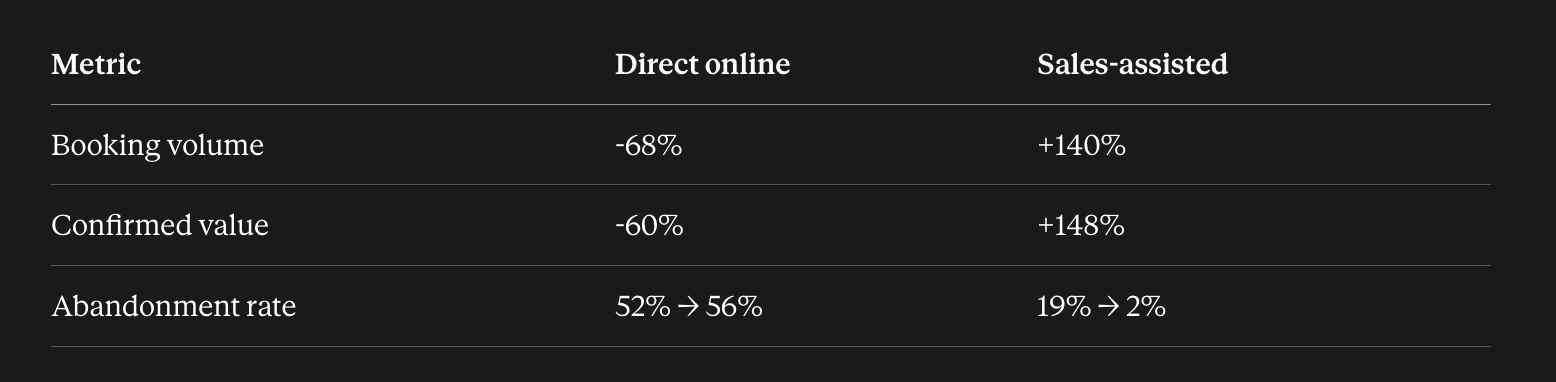
The redesign didn't try to fix the booking flow. It routed more people to the channel that was already working.
The funnel behind the numbers
Every stage of the site was tracked independently to isolate where the changes were landing.
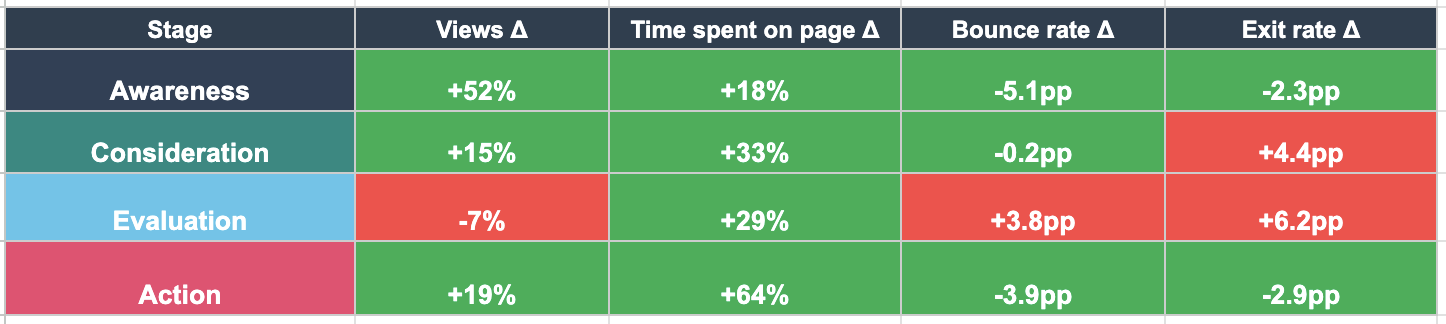
Not every metric moved in the same direction.
Awareness improved because the new homepage answered the first question faster: bounce rate dropped from 52% to 36%. Action improved because Contact became the primary destination instead of a booking flow: page views up 19%, time on page nearly doubled, both bounce and exit rates down.
The middle of the funnel tells a more nuanced story. Consideration-stage time on page rose 33%, meaning visitors are engaging more deeply with expedition and vessel content.
Evaluation views dipped slightly, mainly because we were now surfacing more on this content on the trip pages. Snippets of team bios, the activities and sustainability policies were now on the trip pages so people didn't have to click to find it.
The one-line read
Traffic and engagement up at the top of the funnel. Enquiries and conversions up at the bottom. And a booking channel that was already the strongest one in the business, now doing more than double the volume it was doing before.
Related Work

A Chatbot Became Their #1 Lead Source - Pods4U
Website Design & Conversion Optimisation

$170,000 in Additional Revenue From One Funnel Fix
Donation Flow Optimisation
Stop wasting money on a leaking funnel.
Conversion audits
find & fix conversion leaks
CONVERSION HAUS
Sydney
.png)


